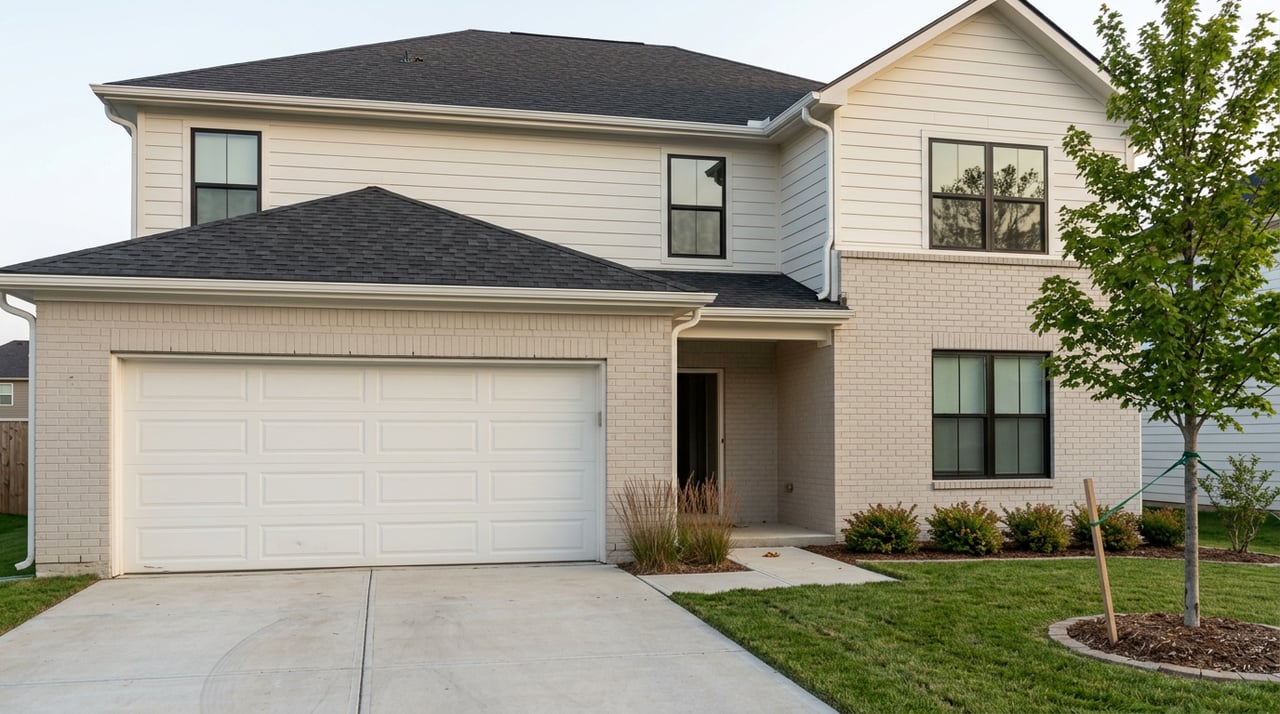
How Spring Hill New Construction Property Taxes Differ
August 20, 2026
August 20, 2026
Say you're comparing two new construction listings in Spring Hill. Both are three or four bedrooms, both sit in the low $500s, both promise a two-car garage and a daylight basement. On paper, they look like the same decision. Underneath the paper, they're not.
One of those homes might sit inside a taxing structure that didn't exist anywhere in Johnson County until a few years ago. The other doesn't. The difference is not square footage; it is the subdivision's financing structure.
Spring Hill is in the middle of an unusually crowded building cycle for a town its size. At least a half dozen subdivisions are active at once, each backed by a different builder, each pulling a slightly different buyer.
| Subdivision | Builder | Reported price band | Financing structure |
|---|---|---|---|
| Fox Hollow (207th & Ridgeview) | Ashlar Homes | From the $330s (2026 builder pricing) | Standard, developer-financed |
| Garrett Ranch (Ridgeview Rd, across from Spring Hill High School) | Arise Homes | Roughly $424K to $576K | Standard, developer-financed |
| Hidden Hills (207th St, east of Woodland Rd) | Hakes Brothers | Roughly $463K to $552K for homes listed May and June 2026 | Standard, developer-financed |
| Wiswell Farms (Hwy 7 and 199th, extending to Woodland Rd) | Ad Astra Land Holdings, developer | Not publicly standardized, scaled across 387 planned single-family homes and 180 multifamily units on 139 acres | Reinvestment Housing Incentive District (RHID), the first in Johnson County |
Three of these four communities work the way new construction has always worked in this corridor. The developer fronts the cost of roads, water, and sewer, then bakes that cost into the price of every lot. Fox Hollow, Garrett Ranch, and Hidden Hills all fall into that category, which is part of why their pricing tracks fairly close to the broader Spring Hill market, where homes were listing at a citywide median price of $441,000 in July 2026 according to Movoto's tracking of the local market.
Wiswell Farms doesn't work that way. It's the one exception on this list, and the mechanism behind it changes what a buyer is actually walking into.
The Kansas Department of Commerce explains that a Reinvestment Housing Incentive District captures the incremental increase in property tax revenue a new development generates. Kansas law allows this capture to run for up to 25 years. When Spring Hill's city council originally structured the Wiswell Farms agreement, it capped that term at 14 years rather than taking the full 25 the statute allows.
As Fox4 reported, the scale is not small. The district covers 139 acres bounded by Highway 169 to the west and Woodland Road to the east, running roughly from 191st Street to 199th Street. The developer, Ad Astra Land Holdings, proposed building approximately 387 single-family homes and 180 multifamily units inside it, along with an extension of Webster Road to serve the new lots. A feasibility analysis from Baker Tilly Municipal Advisors estimated the district would generate roughly $14.4 million in property tax revenue over that 14-year term, money that in a conventional subdivision would flow to the city, the county, and local taxing entities the year it's collected. Inside a RHID, that increment gets held back and used to reimburse the developer for the infrastructure it already built.
Construction on Wiswell Farms began in 2024, and more than 100 homes have sold there since, according to reporting by the Johnson County Post in February 2026. The project is underway and selling. What's different is where the tax dollars those new homeowners generate are actually going for the next decade and a half.
A property tax rate and a property tax mechanism are two different questions. The rate tells you what you'll owe this year. The mechanism tells you where the growth in that bill is being spent for the next fourteen years, and whether you have any say in it.
None of this happens in a vacuum. Spring Hill is trying to build faster than its own infrastructure was originally sized for, and the city's other capital projects show the strain plainly.
Work began in December 2025 on a new stretch of 199th Street running from Ridgeview Road to Renner Road, a 1.21 mile rebuild that will add curbs, stormwater inlets, drainage, sidewalks, and a walking trail alongside the existing corridor near Spring Hill High School's activity complex. Separately, the city started the design phase on a new wastewater treatment facility in late 2025. The current plant, located on Woodland Road between 223rd and 231st Streets, isn't sized to handle the community's continued growth, according to city planning documents referenced in that same February 2026 Johnson County Post report.
Put those two facts next to the RHID and the logic gets easier to see. A city adding this many rooftops this fast has two ways to pay for the roads and pipes underneath them: raise money through general bonds and taxes spread across everyone, or let a specific development's own future tax growth pay its own way. The RHID is Spring Hill choosing the second option for one large, greenfield project on its edge, while the smaller infill-style subdivisions closer to existing roads and utilities didn't need the same tool.
That's a reasonable municipal decision. It's also a distinction buyers may want to understand when comparing model homes.
None of this means a home in Wiswell Farms is a worse buy than one in Garrett Ranch or Fox Hollow. What changes is where the growth in that levy gets spent for a defined stretch of years, and that's worth understanding before you sign, not after.
A few questions worth asking a builder or agent when you're comparing new construction anywhere in this corridor:
None of these questions require a law degree. They require knowing the right term to ask about, which is the whole point of bringing in someone who tracks this market before you write an offer rather than after.
How long does the Wiswell Farms district run? The city structured the agreement with a 14 year cap on revenue capture, shorter than the 25 year maximum the state's RHID statute allows.
Is this common in Johnson County? Not yet. Wiswell Farms was the first Reinvestment Housing Incentive District established in Johnson County when the city council approved it, which is part of why it's worth understanding rather than assuming it works like every other subdivision nearby.
If you're weighing new construction in Spring Hill against something in an established neighborhood, or trying to figure out how a subdivision's financing structure affects your long-term costs, that's a conversation worth having before you tour the model home, not after you've signed a contract. Kirk Home & Land works this corridor closely enough to know which subdivisions carry which structures, and we're glad to walk through what any of it means for your specific situation. Schedule a consultation to discuss your land or home opportunity.
This article is general information, not legal, tax or financial advice. Consult a qualified professional about your situation.
Stay up to date on the latest real estate trends.


Kirk Home & Land true advocacy and full-service resources that markedly result in each client accomplishing their real estate goals. Their warm and trusted Midwest values and attributes shine through, and it is truly their joy to ultimately fulfill their client's request throughout the transaction.